

-Photoroom.png?width=100&name=Image%20(11)-Photoroom.png)
Table of contents
Share this article now!



The most important information at a glance
This article contains affiliate links to HubSpot.
Smart CRM is more than just traditional contact management. It's a centralized, AI-powered database system that connects all HubSpot products, forming the operational core of the platform. The AI analyzes data points in real time, identifies patterns, and provides recommendations for optimizing data sets, sales activities, and customer interactions.
At the same time, the shared data model ensures that all teams work with the same information—regardless of whether they're in sales, marketing, service, or operations.
In practice, this means:
HubSpot Smart CRM thus functions as a strategic infrastructure, not a module. The platform forms a foundation that is robust from the outset and can be easily expanded later.
Smart CRM licensing is clearly structured. Companies can either purchase Smart CRM independently or activate it automatically via premium hub products.
The three editions differ in their range of functions and the depth of their administrative control options.
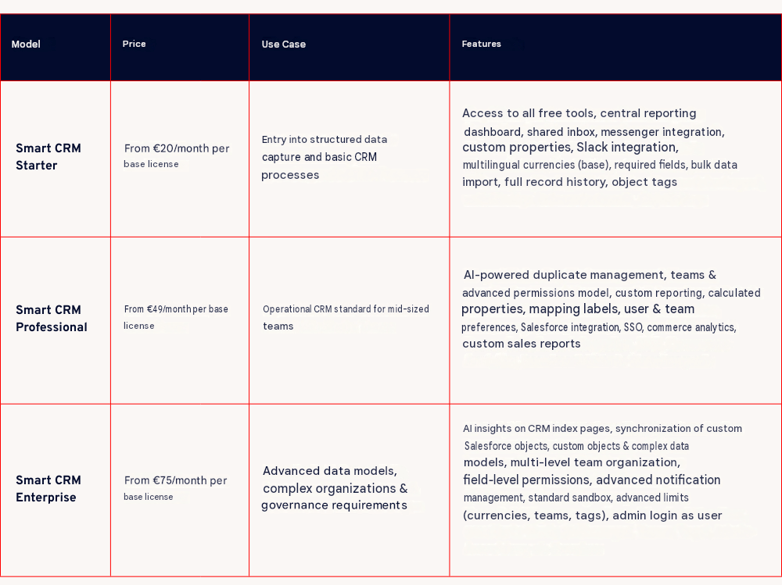
This table deliberately only shows a selection of functions. It serves as a guide, not a complete technical overview.
The following functions are among those that medium-sized companies typically use most in the first 12–24 months of implementing a CRM system.
Companies can create their own attributes for contacts, companies, and deals. This enables a data structure that precisely matches their own sales and service processes.
Initial benefits:
Medium-sized companies rarely work with standardized data models. Custom fields make the CRM system compatible with real business processes.
HubSpot Smart CRM Professional offers automated workflows for lead assignment, follow-ups, status changes, or internal notifications.
Initial benefits::
Even simple automations significantly reduce manual effort and create accountability in teams that previously worked without a defined process model.
Features such as automatic data enrichment, AI recommendations for data hygiene, or error detection help to keep the data basis clean.
Initial benefits::
SMEs in particular struggle with consistent data. An AI that prioritizes quality prevents errors before they spread throughout the organization.
Smart CRM includes a shared team mailbox for email and live chat, as well as integration with Facebook Messenger.
Initial benefits::
Teams gain a central communication channel, thereby reducing information gaps.
Smart CRM offers flexible dashboards for marketing, sales, and service. Companies can see pipeline status, activities, and conversion paths at a glance.
Initial benefits::
Medium-sized organizations can make decisions faster and with higher data quality, without needing separate BI tools.
HubSpot Smart CRM supports bulk data imports and record histories, making data migrations and data corrections easy.
Initial benefits::
Many companies start with Excel or multiple isolated solutions. A stable import function facilitates the transition.
These functional areas work together like a "digital framework" and help SMEs to bring order, transparency and speed to their operational processes.
Many medium-sized companies face similar challenges before implementing a CRM system. Often, there is a lack of transparency regarding customer histories because information is scattered across multiple tools, Excel spreadsheets, and personal email inboxes. Similarly, unclear sales processes arise when activities are not systematically documented or responsibilities between sales, marketing, and service are not clearly defined. Furthermore, inconsistent or duplicate data from various sources compromises data quality and hinders informed decision-making.
Another typical bottleneck is the high manual effort required for follow-ups, especially when teams rely on individual reminders or unsynchronized task lists. This leads to delays, missed opportunities, and processes that are difficult to track.
HubSpot Smart CRM addresses precisely these pain points: Through a central data model, clear process structures, and cross-team visibility, a consistent picture of customer and company data is created. Activities are automatically recorded in the history, responsibilities become transparent, and follow-ups can be managed in a standardized way.
Smart CRM is used in many industries because it is flexible enough to reflect diverse organizational requirements. The following scenarios illustrate typical use cases of how medium-sized companies in the DACH region (Germany, Austria, and Switzerland) use Smart CRM in practice.
In healthcare, clear documentation requirements, structured communication channels, and the coordination of various contacts are often paramount. Smart CRM supports this through centralized communication channels, standardized data structures, and traceable activity histories. Teams can efficiently manage patient and inquiry data and reduce internal coordination processes.
Law firms need a system that clearly structures client acquisition, deadlines, and case categories. Smart CRM makes it possible to map legal attributes as user-defined properties and manage processes transparently. Dashboards provide an overview of work status, workload, and open activities – without the need for additional tools.
Growth-oriented companies in the fintech or SaaS sectors benefit from scalable lead processes, clean data quality, and automated handoffs between marketing, sales, and customer success. Smart CRM simplifies demo requests, qualification logic, and pipeline transparency. Extensions like Sales Hub can be easily integrated later.
In medium-sized industrial companies, sales processes are often complex and heavily driven by offers. Smart CRM supports systematizable sales processes, forecasting, and structured offer follow-up. Automated tasks and transparent deal pipelines improve response times and create reliable forecast data.
Companies differ less in size than in the maturity of their sales and communication processes. Smart CRM supports organizations precisely where existing structures reach their limits and unified customer management becomes necessary. The platform is particularly relevant for companies with historically grown data sets that need to be cleaned up or consolidated. In such situations, Smart CRM creates a reliable data foundation and reduces inconsistencies that arise across different tools or departments.
Organizations with informal or individually tailored sales processes also benefit, as Smart CRM enables clear workflows, traceable activity histories, and standardized pipeline processes. Teams that previously worked with Excel, Outlook, or isolated solutions gain a structured alternative with the central data model, making collaboration and responsibilities more transparent.
For companies that need a single source of truth – a consolidated view of customer, company, and activity data – Smart CRM is the ideal starting point. The system helps them make information usable across teams and make decisions based on consistent data.
This means that Smart CRM is not only aimed at SMEs with certain sales or employee numbers, but at organizations that want to take the next step in professionalizing their customer and sales processes – regardless of their size.
Smart CRM Professional combines a focused range of functions with sufficient depth, without overwhelming mid-sized teams with enterprise-level complexity. Its biggest advantage is that it:
Organizations starting with CRM need:
The Professional model covers exactly these areas completely – nothing more and nothing less.
Smart CRM Professional focuses on the essentials. No redundant modules, no confusing add-ons, no unnecessary learning curve.
As processes in sales, marketing or service become more specific, hubs can be added – without system disruption.
Professional thus becomes a low-threshold, but strategically valuable foundation .
Smart CRM is not an isolated system, but rather the central data core of the entire HubSpot platform. Other hubs extend this foundation depending on their maturity level.
The hubs are built modularly on Smart CRM. Companies don't have to decide in advance which specializations they need – they grow into them organically.
Smart CRM is fundamentally suitable for companies of all sizes because the underlying data model is scalable. However, it is particularly common in medium-sized businesses in the DACH region – that is, in organizations with multiple departments, clearly defined sales or service processes, and a need for a central database. Small teams benefit from the structured entry point of the Starter package, while growing companies can leverage the Professional package for additional reporting, quality assurance, and team-building features. The Enterprise package is suitable when governance, complex data models, or multi-tiered organizational units are key considerations.
Yes. Smart CRM features comprehensive import, mapping, and validation capabilities that cleanly transfer large volumes of data into the system. CSV exports, previous CRM systems, or Excel spreadsheets can be integrated quickly. Additionally, AI features such as duplicate checking and automatic data enrichment help ensure data quality after import. Companies already using many heterogeneous data sources can later add further integrations via the Data Hub.
Smart CRM offers several mechanisms to ensure data quality: AI-powered duplicate identification, mandatory fields, calculated attributes, enrichment functions, and a complete record history. This allows companies to maintain control over the origin, modification, and use of their data at all times. For GDPR-compliant processing, HubSpot provides features for consent management, logging, and exportability. The transparency of the data model also facilitates internal audits and documented processes.
Yes. Smart CRM is intentionally modular. Companies can add Marketing, Sales, Service, or Data Hubs at any time without restructuring existing data or redesigning processes. The Starter, Professional, and Enterprise editions are fully compatible; a later upgrade expands the existing functionality without altering the underlying system. This creates a scalable path from a simple entry point to a complex CRM landscape, without system migration or operational disruption.
HubSpot Smart CRM offers medium-sized businesses a practical and structured path into the world of CRM. The platform connects data, processes, and teams in a unified system without burdening companies with unnecessary complexity. Smart CRM Professional, in particular , provides an economical, functionally balanced, and scalable entry point that can be easily expanded later with specialized hubs.
This makes Smart CRM not just a first step, but a reliable foundation for long-term growth strategies.
-Photoroom.png?width=280&name=Image%20(11)-Photoroom.png)
 Email Laura Virginia: llicatatiso@kkvision.de
For mid-sized businesses, CRM reporting isn't about data collection, but about transforming data into actionable insights. Leaders need dashboards that quickly answer strategic questions: Are we...
The integration of HubSpot and DATEV automates the transfer of customer, deal, and invoice data between CRM and accounting, significantly reducing manual reconciliation. This enables companies to...
This article shows how the CRM intelligently combines data protection and sales through European data centers, integrated compliance functions and automation with Workflow Builder and Breeze AI.